Gazebo assembly in Dallas, on the slab or deck you've already got
A steel hardtop or a louvered aluminium pergola, built to its manual with every post anchored down. Inside a Landmark district, the certificate has to come first.
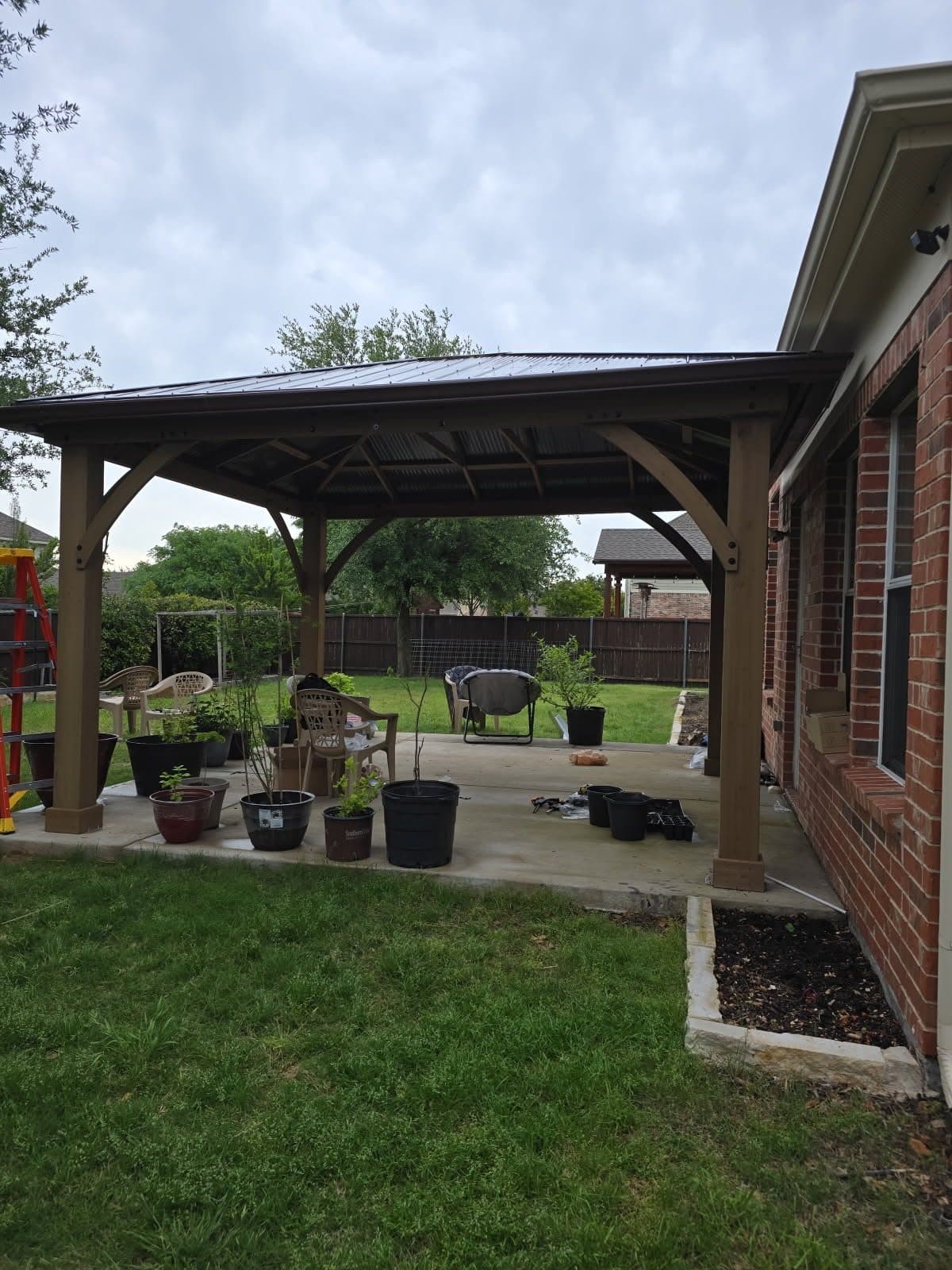
LocalHandyPro does gazebo assembly in Dallas for kits that show up on a pallet, from steel hardtops to louvered aluminium pergolas. We build each one to its manual and drill the post anchors into the slab, deck or pavers already in the yard. The kits themselves, and how the anchoring works, are on the gazebo and pergola assembly page. In Dallas the kit is rarely the hard part.
What Dallas back yards do to the job
Start with the slope. Lake Highlands is hilly by Dallas standards, with streets that rise and fall about 50 feet, and Kessler Park in north Oak Cliff rolls too, so on a lot there the patio slab can be the only flat ground in the yard and the gazebo goes wherever the slab happens to be. No slab, or one that tilts more than shims can take up, means a concrete crew comes first; we don't pour, and we don't level ground. Kessler Park also has big old trees. We'd rather not set a hardtop under a limb that already drops twigs on the patio table, and we'll say so when we see the photos. Cutting it back is an arborist's call.
Preston Hollow filled in during the 1930s on estate-sized lots, and there's room back there for a 12 by 20 kit or bigger. At that size you're past 200 square feet, where nothing on Dallas's permit-free list applies.
How close to the fence can it go?
Dallas lets a detached, one-story patio cover under 200 square feet go up on a house or duplex lot without a permit, and a small freestanding kit is the nearest thing to it on that list. The city's building inspection FAQ adds a line most people skip: even that cover can't stand in a front or side yard setback. How deep those run depends on the zoning. An R-7.5(A) lot keeps 5 feet clear along each side and 25 at the front, R-16(A) wants 10 at the sides, and a plat can draw its own building line on top. Measure from the property line on the survey. Fences wander.
A pergola bolted to the back wall is its own question. The city's development guide puts a porch or deck under an alteration permit once it's attached to the house or has a roof, and that kind of kit looks a lot like a porch cover, so ask the city before it ships. If it needs a permit, we put the build on the calendar for after it's issued.
A gazebo behind a Landmark house
In a Dallas Landmark district, a new structure needs a Certificate of Appropriateness before it goes up, and a gazebo is a structure. The Landmark Commission's minutes show how closely it looks. In 2016 it approved a wood pergola at the back of a house in Peak's Suburban Addition on condition that it met the 8-foot setback in that district's rules for accessory buildings, and a 2008 Munger Place request for a 12 by 12 pergola spelled out the post size, the paint color and a finished height of no more than 8 feet 6 inches. That one was cut from lumber, which is a builder's job, not ours. A kit gets asked the same questions.
Applications close on the fourth Monday of the month. A neighborhood task force looks first (the city's page says, in capitals, that its decisions are RECOMMENDATIONS ONLY), the commission usually sits on the first Monday of the next month, and the signed certificate follows about 10 days after the hearing. A missed deadline costs a month. We'd hold off ordering the kit until the certificate is in hand; a month of stepping around the boxes in the garage gets old.
The conservation districts, Kessler Park and the M Streets among them, ask less. Exterior work there needs a conservation district work certificate from the district's staff. Our Dallas page has more on both kinds of district.
Inside the city limit, and past it
We go all over the city, from Lake Highlands down to Winnetka Heights in Oak Cliff, and into Highland Park and University Park, which Dallas surrounds but which keep their own permit offices.
Past the city limit the line only drops. Plano exempts a detached gazebo only up to 120 square feet. Garland wants a permit for one over 20, which catches any gazebo you could sit in, and Irving counts height as a dimension, so a pergola or gazebo taller than 6 feet (all of them) needs one there. Carrollton asks for a permit at any size.
How booking works
Send the job
Tell us which kit it is, how big, and where it's going, with a photo of the spot.
Get the price
We reply within 24 hours with one price for the whole list. Nothing is booked until you say yes.
Look it over with us
Before we pack up, you walk through the finished work with whoever did it.
Before you book
Most of these turn on the base and the paperwork. With your request, send the kit's brand and model (or the listing), its footprint in feet, and photos of whatever it will stand on.
Call (469) 577-1791On a house lot, detached and one story, probably not: at 100 square feet it's well under the city's 200-square-foot line for patio covers. It still has to sit outside the front and side setbacks. In a Landmark district it needs a certificate whatever its size, and an HOA or a deed restriction can say no where the city says yes.
Rarely. Patios are poured with a fall so rain runs off, and the post bases get shimmed to take it up. A slab that's cracked and heaved is different, and goes to a concrete crew first.
No, but we can pencil in a date for when it comes through.
A freestanding one, usually, as long as the joists under it are sound; send a photo from underneath if you can get one. If the deck is attached to the house, a roof over it is the case the city's guide sends to an alteration permit, so check with the city first.
Yes. It weighs much less than a hardtop, and the canopy catches wind all the same.
Not us. A licensed electrician runs that circuit once our installation is finished.